Treasures Age Old - Session 12 Player Recap
Present: Charlie Betts, Oscar Katz, Sam Bebbington, Robert Nettleton
Last Session: Treasures Age Old - Session 11 Player Recap
Opening Position
Bruno and Polonius were not active during this part of the expedition. The immediate decisions therefore fell to Marco, Peg, and Barry, accompanied by Tlali and Pulo.
The party remained in Freeport, which was still trapped behind Gustavo's maritime blockade. Their immediate objective was to recover the tattooed skin removed from Little Foot before his death. Belladonna possessed the remainder of Little Foot's corpse, but Redd James and Grizzlebeard were believed to have taken the tattoo.
Beyond the reefs and fog, Gustavo's ships watched every recognised route from the harbour. The Red Scorn, Ursa Major and the Chained Hag were all effectively trapped, although few members of the Ursa Major's original crew remained alive. Gustavo was not conducting an ordinary siege for profit. His obsession with eradicating Little Foot and everything connected to him potentially extended to the party themselves.
The previous evening, the party had kidnapped and interrogated Jolliver. He had eventually admitted that Redd James, Rederick, Grizzlebeard, Redd James Junior, and one other trusted sailor had departed in a small, unmarked sail-and-oar boat. They had travelled towards the river and apparently used a concealed route through the cliffs to escape Freeport without confronting the blockade.
Rederick was Redd's medic brother, although his experiences in Amokuali Temple had left him terrified of blood touching the floor. Redd James Junior was not Redd's biological son, but a young boy in whom Redd believed he saw considerable potential.
Their likely objective was to locate Professor Wrinkleleaf Bailey, who might be waiting in or near Atzalco. They intended to obtain a larger ship beyond the blockade and send somebody back through the concealed route to guide or extract the remaining crews of The Red Scorn and Ursa Major. The party suspected that Grizzlebeard still carried Little Foot's tattooed skin.
The neighbour who saw Redd and Grizzlebeard visiting Bennett's ruined home had watched them leave and proceed down the street, but had not followed them beyond the next turning. The party therefore established that Bennett's property was not itself the secret entrance. It had provided clues or preparation rather than direct access to the tunnel.
The party's position in Freeport was becoming increasingly precarious. Their attempt to infiltrate The Red Scorn had ended with Howell Baldwin being shot and another unconscious member of Redd's crew having his throat cut before being thrown into the harbour. The crew knew who had attacked them and had fired muskets after the escaping party. Redd himself had not yet heard the full account, but whatever remained of their association with him was likely to deteriorate when he did.
Belladonna had tortured the abducted Jolliver for information. She continued to regard the party as potentially useful associates, but not as trusted members of her hierarchy. Her protection was conditional upon their continued usefulness; if they became more troublesome than valuable, she could simply surrender them to the Pirate Lords. Belladonna Velenza also hoped that Isabel Del Oro might pay something for Little Foot's corpse even without the missing tattoo, but recovering the tattoo remained the greater prize.
The stolen Swooping Terror had now been turned into an official-looking arrangement with the Freeport hangar, but this had not erased the witnesses. Hangar personnel still knew who had abducted Fernando. The Alley Rats had already attempted to collect the party's bounties, and Freeport's authorities could connect the group with numerous killings, the public attack upon the Chained Hag, and the destruction of another Swooping Terror. Freeport tolerated extraordinary violence, but the Pirate Lords still required enough order to keep the port functioning.
The official arrangement had been accepted by a hangar representative who was eager to be remembered favourably if Belladonna became a Pirate Lord. Elsewhere, the severely wounded Garnot had been left inside a barrel and handed to two strangers. The authorities could also connect the party to the death of Joan Ackworth, although her descent over a cliff had at least been spectacular enough to suit Freeport's sensibilities.
The trouble was that nobody in the party knew where the concealed route began.
They knew that deliberately searching for a concealed entrance would normally require the same sort of expertise used to identify traps and hidden mechanisms. Someone with sufficiently detailed knowledge of Freeport might instead simply know where it was. Peg Meg-Leg had already tested the limits of her local knowledge on this question. It led her to Belladonna, who knew the broad story that an old cave route might exist somewhere in the cliffs, but not its location or means of entry. Even one of the most powerful and well-informed captains in the city could offer no more than that.
It was approximately 10:00-10:30 p.m. Barry was awake but still severely injured from the loss of his left leg. The group briefly considered bringing Jolliver with them, either as a guide or so that he could corroborate their version of events. They abandoned this idea because he claimed not to know the entrance and remained an unwilling captive who would seize any opportunity to return to The Red Scorn.
They also considered ignoring the hidden route entirely and using the newly regularised Swooping Terror arrangement to fly people to Atzalco one or two at a time. That was practical but slow, conspicuous, and profoundly lacking in the kind of adventure they expected from pursuing Redd James. Following the route that had slipped through Gustavo's blockade promised both a better story and a chance to discover something strategically valuable.
The party initially contemplated simply boarding Tlali, travelling upriver, and hoping they encountered the entrance. Barry's overconfidence made this appealing. However, the river cliffs contained numerous caves, tributaries, overhangs, and stretches of dense jungle. Random searching in darkness could consume the whole night while allowing Redd James to increase his lead.
Looking for Somebody Who Knew Freeport
The party considered who might know old stories, forgotten routes, or secrets predating pirate control of Freeport. Belladonna possessed extensive local knowledge, but even she did not know the tunnel's location. Bennett's home had once contained the closest thing Freeport possessed to a serious private library, but Edward Jenkins and his followers had stripped the property almost bare.
That made Edward Jenkins relevant again. His gang had taken many of Bennett's books and papers, even if they did not understand their significance. More importantly, Edward Jenkins trusted the strange intuitions of Hunchback Jim, a six-year-old child associated with his group. Edward maintained that Jim's hunches were reliable even when they initially appeared wrong: if a hunch failed, that merely meant everyone else had misunderstood it.
The party remembered that they had previously examined only a few of Bennett's books, looking specifically for material relevant to Little Foot, Amokuali Temple, and local supernatural legends. They had never searched the collection for secret passages beneath Freeport. The information could therefore have been present without anybody recognising its value.
They briefly discussed returning to the Slippery Three. The sisters knew numerous fragments of local occult lore, and Barry's severed leg might make an appropriate gift. The party decided against this. The sisters were far from reliable, and reaching them would lead away from the river while time mattered.
Edward Jenkins himself was not automatically hostile. Although many people now wanted the party's bounties, he had previously profited from dealing with them. His gang had received Bennett's books, and Edward had purchased a valuable ring from them for approximately $300 after catastrophically underestimating its true value. From the party's perspective, he might still regard them as useful associates rather than immediate prey.
Edward was no longer expected to be using the private room at the Crossed Keys. He had rented it only long enough to inspect and divide loot. He was sufficiently reluctant to waste money that he characteristically avoided paying for the same private room for more than two days.
The party decided to visit Gangplank Gardens, where Edward Jenkins and many of his followers lived. Because the party were now recognisable wanted criminals carrying substantial bounties, they first considered their disguises.
Peg wanted something more convincing than the collection of filthy cloth and rags the group had previously used. Her knowledge of Freeport led her to a second-hand clothing merchant named Good Will, whose shop occupied a former dockside tavern. The old bar remained as the counter, scratched by years of glasses, knives, food, and rough use. Clothing hung from improvised racks made from repurposed poles and dulled weapons. The room smelled of damp fabric because much of the stock had come directly from looted ships, dead owners, or people selling whatever they no longer needed.
Good Will had recently done excellent business selling false beards, walking sticks, old men's clothing, and other materials to people hoping to manufacture counterfeit versions of Little Foot. By the time Peg arrived, most of the best old-man disguises had already been sold.
A woman was inside the shop sizing clothing against an elderly man, providing direct evidence that the counterfeit trade remained active. Peg first joked about buying a child disguise and then asked whether Good Will possessed anything resembling the ceremonial appearance of the Gestalt assassins. Good Will observed that successful assassins generally travelled in ordinary civilian clothing and that anybody selling their distinctive killing attire would first have needed to defeat one of them.
Peg instead asked for something that would conceal her shape and identity. Good Will produced the only nun's habit he possessed. It was a Conquistador religious garment that had once been white, but age, dirt, blood, and neglect had stained much of it grey or pink. The front bore the image of Caelor's sun with two needles passing around or behind it. A hood and drawstring concealed much of the wearer's face.
Peg bought the garment for approximately $120 and gave Good Will the remainder of the $200 she had available in exchange for his discretion. If anybody later asked whether Peg Meg-Leg had entered the shop, he would remember only that he had served a nun. Peg changed behind the former tavern, avoiding its deeply unpleasant old outhouse, and stuffed parts of her previous disguise beneath the habit to alter her silhouette further. The result was an unusually broad or heavily built nun.
Good Will recognised Peg despite the imperfect wanted descriptions circulating through town. Those descriptions could not agree on whether she wore a beard, and none included a useful "leg print," but her name and missing limb made her difficult to mistake. His willingness to sell the outfit and promise discretion was therefore commercially useful rather than evidence that the disguise had already fooled everybody.
Marco and Barry retained their ragged disguises. Together, the three could plausibly resemble a nun escorting or ministering to two disreputable vagrants. Peg offered religious warnings, blessings and injunctions to repent to anybody who looked too closely. The sight of a Caelor-worshipping nun encouraged many people to avert their eyes rather than risk attracting ecclesiastical attention or being reported, corrected or abducted by an unusually zealous rogue nun.
Gangplank Gardens
Gangplank Gardens had once been a respectable public garden serving a prosperous part of Freeport. In practice, even before the pirate takeover, poorer residents had frequently been turned away for failing to dress appropriately. After pirates took the city, the open land attracted shacks, sheds, and improvised houses. Repeated fighting over the desirable ground eventually ruined much of what remained.
Only fragments of the old boundary survived. Sections of stonework remained, while much of the metal fencing had been stolen and repurposed elsewhere. Inside, the former lawns had become churned mud. Rubbish lined the narrow routes between structures, and the district smelled of refuse and people living without adequate sanitation. Lanterns glowed behind walls and shutters, but the streets themselves were poorly lit and dangerous after dark.
Near the centre, roughly twenty members and dependants of Edward Jenkins' gang occupied a ring of sheds, shacks and improvised houses built around the ancient tree. Many rallied behind Edward because he helped them retain this foothold in a formerly wealthy district, rather than from unwavering personal loyalty. Without a recognised leader, rival groups might drive them from the Gangplank Gardens altogether.
The party used their familiarity with criminal etiquette to find somebody associated with Edward Jenkins. They approached a burly, scarred man from the gang who was clearing rubbish from one of the paths. He seemed to occupy an informal position of authority and was known as Henchman Harry.
Harry was in an unusually good mood and accepted the disguised party's explanation that they required urgent guidance. He knew where Hunchback Jim had gone, or at least where he had last been seen.
Marco's familiarity with criminal etiquette helped them approach him without appearing to challenge the gang. Barry Cuda praised the work he was doing to keep the paths clear and, when leaving, kicked a piece of rubbish slightly further aside as a token contribution.
Hunchback Jim had left Gangplank Gardens approximately an hour earlier. He had insisted on wearing something red and had gone towards the central square, carrying a book but no food. Before leaving, he had told Edward Jenkins that Edward Jenkins should go with him. Edward Jenkins declined because he had seen the square "a thousand times" and saw no reason to follow a child there in the middle of the night. He allowed Jim to go and play, expecting him to return.
Jim did sometimes wander away while following his hunches, but he had already been gone much longer than the ten minutes normally required to reach the square. Harry and the others had planned to search for him if he had not returned by midnight.
Harry explained something of Jim's place within the gang's beliefs. Edward Jenkins and his followers maintained that the child had been found beneath the roots of the great old tree around which their settlement had formed. Some believed he had been born from the tree and inherited its age or wisdom.
Harry gave the gang's rule for interpreting Jim's prophecies almost word for word:
Whenever he's right, Hunchback Jim was right. If he's wrong, he was still right. We just didn't listen close enough.
Harry conceded that Jim was not equally clear every time, but insisted that the child was "often more right than he is less right." Jim did not usually provide a complete explanation. He supplied a direction, image or peculiar statement whose meaning might only become apparent after somebody acted upon it.
They consulted him before burglaries, gambling, ship arrivals, and other uncertain ventures. Harry described asking Jim which house the gang should "visit" to help the occupants move their property permanently, when a ship might arrive ready for them to distribute unwanted goods, and when they ought to gamble. They also asked what the great tree needed in order to grow.
At different times, Jim had offered advice concerning the health of the tree. The gang had apparently tried setting it on fire, only to discover that this harmed it. Jim had told them plainly that they must not allow the tree to burn.
The gang's explanations concerning the tree were inconsistent. Some believed Jim had been born from or discovered beneath its roots; versions of the story occasionally shifted the details onto Edward Jenkins. More importantly, Harry repeated several extremely specific things Jim had said about its future.
They needed to keep Hunchback Jim around for as long as possible. As Jim aged, the tree might lose its age. It would become progressively younger and might eventually diminish all the way into a simple seed. Jim repeatedly spoke about the tree becoming young again and said that this could happen "if only Hunchback Jim could have it watered it the special way." The party assumed that this, of course, meant urination.
Some in the gang described Jim as an offshoot, fruit or child of the tree itself: its age and accumulated wisdom given a small, wrinkled human form. This was not presented as settled doctrine, but it helped explain why his strangest statements about the tree were taken seriously.
At the time, these claims sounded like peculiar garden lore built around a prophetic child and an ancient tree. Nobody present could determine whether "water it" meant ordinary water, some particular substance, an action Jim would perform later, or something still more metaphorical. The party moved on without resolving it.
Harry added one detail that made the party considerably more interested: Jim had specifically chosen to wear red before going to the statue.
Before leaving, the party also asked whether Harry had seen Redd James. Harry knew who Redd was and knew of his connection with Grizzlebeard, but had not seen him pass through Gangplank Gardens. This ruled out the easiest possibility that Jim had simply followed Redd or received directions from him. Whatever had taken Jim to the square appeared to be his own hunch.
As they left, the party kicked another piece of rubbish farther away from the path Harry had been clearing. It was a tiny gesture, but it reinforced that they had approached him according to the district's etiquette rather than merely demanding information.
The party bought several meat and cassava wraps from a nearby vendor, intending to use food to coax information from the hungry child. They then headed towards Freeport's principal square.
The wraps contained cassava and minced dinosaur meat that could not confidently be attributed to any single species. Jim had left without provisions, and Henchman Harry had specifically warned that he would probably be hungry.
The Square and Edward Stormbreaker
Unlike most open land in Freeport, the central square had not been consumed by uncontrolled construction. The Pirate Lords had preserved it as a place for public gatherings, auctions, government business, and religious observance.
The square contained the city government building, a maintained church, and several properties belonging to wealthy or influential residents. The customs house hosted the sale and distribution of captured cargo. It was the sort of place through which Redd James' stolen tin and lumber might have passed after reaching port.
At the centre stood a large statue of Edward Stormbreaker, the pirate traditionally credited with taking Freeport from the Conquistadors. The statue presented Edward Stormbreaker as an idealised pirate conqueror: magnificent hat, beard, eyepatch, hook, dramatic clothing, and a parrot perched upon his shoulder. One arm extended outward as if reaching for or grasping something beyond the square.
Inscriptions around the plinth recorded the conquest in both Conquistadan and East Azcelani, naming Edward Stormbreaker and members of his force while presenting their victory as the liberation of Freeport from colonial rule.
According to the official pirate legend, Freeport had once been an unconquerable Conquistador stronghold. Stormbreaker and approximately 120 followers had overcome its defences by riding a bolt of lightning directly into the city. The lightning struck the place where the statue now stood, and the entire force materialised within the walls before capturing the town.
The party already suspected that the legend concealed a more practical infiltration route.
Near the statue, they found Hunchback Jim trying unsuccessfully to climb the plinth. His hunch made the ascent difficult. He wore an oversized red cape that covered his back without trailing badly enough to trip him. In one hand he carried a leather-bound book with a clasp. The lock that might once have secured it was missing.
Before finding Jim, Barry Cuda stood in the square holding one of the wraps and trusting that hunger and destiny would bring the child to him. A young couple wearing red sat upon one of the paired courtship benches nearby. One of them dropped his own wrap during an anxious conversation about the siege. The silence that followed helped the party hear Jim struggling beside the statue.
Peg and the others offered Jim one of the wraps. As soon as he turned towards them, his hunch seemed to shake and his whole body shuddered slightly. He recognised them despite their disguises.
I recognise you. I thought someone might come.
Once given the food, he took several bites and explained what he was trying to do:
I need to give the statue... I need to give Edward his book.
The distinction mattered. Jim did not say that they needed the book or that they should read it first. In his understanding, the book belonged in the stone hand of Edward Stormbreaker.
When asked what was inside, Jim struggled to explain. The book did not make sense to him and he saw no point in the party trying to read it before doing what his hunch required. When pressed, he became emphatic:
Shut it. Shut it. Shut it. The words are unclear and jumbled. There's so much of it which doesn't make sense.
This did not mean that the book contained meaningless writing. Jim could not read it conventionally, and his gift had given him a direction rather than a translation. The party offered to help him climb. He handed over the book and ate the wrap with both hands while directing their ascent. His warnings about which parts of the statue to hold helped them find secure handholds.
The climb attracted unusual looks from people crossing the square. Under ordinary circumstances, climbing over the city's great monument to its pirate conqueror would probably have brought guards, officials or offended residents. The siege occupied enough attention that nobody intervened before the party completed the experiment.
The tome resembled a notebook or collected manuscript rather than an ordinary printed book. Its leather cover bore no useful title, and its pages were not numbered. The party climbed the statue and placed it in Edward Stormbreaker's open hand. The angle of the stone fingers caused the book to fall open naturally at a particular section.
As the pages settled open, Jim watched the statue and announced with sudden excitement:
He's reading. He's reading.
The book's weight and the angle of the statue's hand mattered. When it was placed naturally across the palm, a particular quantity of pages fell to either side, selecting the passage without Jim needing to read or identify a page number. This appeared to be the actual purpose of placing it in Edward Stormbreaker's hand.
During the discussion, somebody suggested taking the book to the Slippery Three, who had previously demonstrated an ability to give statues strange new qualities. Jim responded immediately:
Don't take me there.
He did not explain whether he feared the sisters personally, foresaw a specific consequence, or simply understood that their involvement was wrong. The party did not pursue the suggestion.
Nothing supernatural visibly happened. No door opened beneath the statue, and no lightning struck the square. Jim's excitement turned into concern. He first said that Edward Stormbreaker was trying to read it, and then that he could not:
He's Edward Stormbreaker. He's trying to read it, but he can't.
When the party proposed taking the book down to find better light, Jim added:
He will never be able to read it.
The party marked the selected place with a finger and took the book back down. At the time, this appeared to mean only that a stone statue could not literally read. As with Jim's other statements, the precise wording was left unresolved.
The Poem
As Jim followed the party towards a street lantern, he returned to another part of his hunch. He had expected people with "bare hands and red" to go to the statue:
I just thought that people with bare hands and red would be going to that statue. But you guys aren't.
The party proposed several interpretations. It might refer to Redd James, whose name and clothing both suggested red. It might refer to the young couple in red sitting nearby. "Bare hands" might mean unarmed people, empty hands, literal uncovered hands, or something they had not yet encountered. Jim did not resolve the ambiguity. He simply knew that the people he had expected were not the disguised party standing before him.
Jim continued following partly because he wanted his book returned, but also because his hunch suggested that he might discover something interesting by remaining with them. Under the streetlamp, he repeatedly tried to jump high enough to see the selected text while the taller adults held the book above him.
The selected passage was written in East Azcelani script. None of the three active party members could read it. When asked where they could find somebody to translate, Jim answered with another fragment:
Words were spoken. They can come through another way.
He then corrected or refined it:
Generous words.
Jim gave no name or destination. The party had to determine what act of generosity the words referred to and through whom they might return.
This pointed them back towards the young couple sitting in the square. One of the pair had earlier dropped his own wrap, and the party had generously replaced it. When approached, he revealed that he could read East Azcelani. He had studied at Confluence University and had come to Freeport hoping to visit his former professor, Bennett.
The coincidence appeared to match Jim's statement about generous words passing through another person. Barry Cuda had just given the young man his own wrap after the man's food fell to the ground. That unsolicited generosity had created both the goodwill and the exact translator required. The "generous words" came back through the person who had received the generous act. This solved the immediate problem, although the party had no proof that it exhausted every meaning of Jim's phrase.
In gratitude for the food, he translated the selected poem:
Where thunder cast the conqueror down,
Stone keeps watch above the town.The victor looks upon his prize;
Trust not the direction of his eyes.The only witness bears no sword,
And turns its back upon its lord.Follow its gaze beyond the quay,
To three black teeth within the sea.Beneath the tooth whose crown is torn,
Wait until the tide is drawn.Seek the shadow that returns no light;
Part the leaves and enter night.
The party quickly identified the "victor" as Edward Stormbreaker. His own gaze and extended hand were distractions. The "only witness" who bore no sword and turned away from his lord was the parrot on his shoulder.
The party spent time establishing whether a parrot's side-facing eyes could meaningfully indicate one direction. By comparing the orientation of its head, beak and visible eye, they concluded that the sculpted bird possessed a deliberate sightline distinct from Edward Stormbreaker's own.
When they examined the statue carefully, they found that the parrot was looking away from Edward Stormbreaker and slightly towards the river. Its line of sight continued beyond the quay and intersected the far bank upstream from the harbour.
Edward Stormbreaker himself faced towards his conquered city and harbour, fitting the line that the victor looked upon his prize. The parrot's gaze was therefore deliberately distinct from both the man's face and his extended hand. The party used the line between its eye and beak as their bearing.
The fog and darkness prevented them from seeing the three black teeth immediately. However, they used a compass and the statue's orientation to preserve the bearing. The poem suggested that the entrance could only be identified reliably at low tide, behind a broken-topped rock, where foliage concealed a cave whose darkness reflected no exterior light.
They reasoned that rocks on the far riverbank might appear to stand within the sea when viewed through Freeport's heavy fog, particularly to generations of pirates wearing eyepatches and possessing poor depth perception. The phrase did not necessarily require three literal offshore stacks.
Hunchback Jim wanted his book returned. The party had copied the translation, so they gave it back along with $5. Jim thanked them and offered one final remark:
I hope the book ends up making sense to you.
He then hobbled back towards Gangplank Gardens with the book and a wrap. Whatever had led Jim to the statue had given the party the first coherent directions to the concealed route, but they had not necessarily understood everything he said or everything his hunch had predicted.
After Jim departed, the party debated how the book had reached him and what that implied. Bennett had originally owned it; Edward Jenkins had looted it; Jim had then selected it through a hunch. Perhaps Redd had already seen the relevant directions. Perhaps he had set out with only a rough hope of finding the passage. Perhaps Jim had taken and retained the book because allowing somebody else to possess it would eventually lead to him being threatened or tortured for its contents. They had no firm answer.
Waiting for Low Tide
It was now around midnight. The tide had passed its previous low point and would not be suitably drawn again until morning. The darkness and fog also made it almost impossible to distinguish distant black rocks against the far bank.
The party worked through the tide timings. Low tide had been at roughly 8:00 p.m.; the water would reach its highest point at around 2:00 a.m. and then withdraw to another low at approximately 8:00 a.m. The poem did not demand one exact instant, but an entrance concealed close to the waterline would be safest and easiest to recognise near the bottom of the cycle. They therefore had most of the night to wait.
They initially considered walking directly along the compass bearing and searching immediately. Once they reached the quay, however, the fog and darkness prevented them from distinguishing the far tree line, let alone three individual rocks. Rather than wander blindly, they proceeded to the riverside intersection indicated by the bearing and waited for daylight and lower water.
The party followed the parrot's bearing to the riverside and established a rough camp. Tlali remained available in the water. The group used military experience to arrange the exposed site successfully enough that all three could receive the benefit of several hours' proper rest.
They woke at approximately 6:30-7:00 a.m., as daylight began to spread through the fog. The river had receded considerably, revealing more mud and stone along the banks. The party searched the opposite side along the bearing supplied by the parrot.
Bruno was not active to prepare breakfast, so the party relied upon remaining wraps, carried alcohol, and whatever minor provisions they already possessed. The rest was enough to prevent immediate exhaustion but did not meaningfully heal their existing injuries.
In daylight they saw three tall, dark rock formations rising above the surrounding vegetation. From the square, poor visibility and pirate eyepatches might make them appear to stand in the sea, even though they were associated with the far riverbank. They were not identical: one was shorter, another taller, and the central formation had lost its crown. Its broken summit formed a jagged spike.
The rocks were black and strangely bare near their tops. Vines climbed their lower surfaces but stopped abruptly above a certain height, leaving the upper stone without nests, shrubs, or other obvious signs of life.
The middle tooth was the one whose crown was torn.
The Boy Beside the River
Before crossing, the party noticed a local boy skimming stones from the near bank. His father was fishing further upstream, still within shouting distance.
The boy warned them about the caves across the water. His older sister, Juliette, had loved skimming stones from the same place. When she was approximately his age, she had swum across the river while trying to retrieve or follow stones she had thrown. She never returned. Her body had never been recovered.
Juliette had disappeared before the boy was born. His account came from what his father had told him rather than a memory of witnessing her departure. She had specifically crossed because she wanted to collect the stones she had successfully skipped to the far side.
His father had forbidden him from entering the tunnels. Local stories associated the place with disappearances, death, and the loss of good fortune. The boy nevertheless continued visiting the river and skimming stones, partly because this was something he had once shared with Juliette.
The party promised that they would look for his sister.
The boy had also seen something much more recent. At approximately 10:00 p.m. on the night before Redd James made his escape, five men had emerged from the caves in a boat. They had behaved quietly, appeared to know one another, and could have passed for merchants, mercenaries, or sailors. The boy had not heard them say anything useful.
The men had come out of the caves and entered Freeport, rather than travelling into the passage. This distinction mattered. They preceded Redd James' departure and could not simply have been his group observed at the wrong time.
The boy did not initially volunteer every detail as a formal witness. The information emerged through the party's questions while they spoke about Juliette, the caves, and recent boats. Peg gave him $5 and encouraged him to buy a wrap. The group resisted suggestions that he accompany them, and he obeyed his father's warning to remain on the safe bank.
This meant that another organised group had used the secret route approximately ten hours before Redd James' five-person party entered it from the Freeport side. The party did not know who they were, but the timing and secrecy made them significant.
The boy indicated the general cave area. He remained on the bank rather than joining the expedition, respecting his father's warnings even while continuing to hope that Juliette might somehow return.
The boy had approached while the party prepared to cross and repeated that his father had forbidden him from entering the tunnels. There was brief talk of bringing him along or making him an apprentice, but the party ultimately told him to obey his father and remain within shouting distance of the fisherman.
Crossing the River
The party mounted Tlali for the crossing. Marco took control of her movement. Pulo swam alongside rather than attempting to cling to her back. Peg removed the padding from beneath the nun's habit and changed back into more practical pirate equipment.
The group considered how to carry weapons while riding an aquatic dinosaur. They discussed obtaining a rope or safety line in case somebody fell. Their pistols and powder were vulnerable to water, so they relied upon cutlasses and whatever equipment could survive being soaked. Peg initially considered keeping a loaded pistol ready, but the combination of damp powder, possible malfunction and the danger of carrying a loaded firearm over water persuaded her to use her cutlass. Some riders held with both hands; others accepted less security in order to keep a weapon or torch available.
Barry Cuda could not swim. Peg could, but any heavy load would make the water more dangerous. Barry treated his inability to swim as an expression of confidence in Tlali: learning would suggest insufficient faith in his mount. Marco took the front position as Tlali's rider, Barry Cuda occupied the middle, and Peg rode towards the rear. Pulo required no place on Tlali because he could follow through the water.
Tlali carried them safely across the main channel. The far bank was steep, wet, and densely covered in roots and vegetation. The group initially believed that the entrance might lie higher among the rocks. They dismounted and climbed through the slippery vegetation around the broken tooth.
The crossing itself carried them out of the noise of the city. The calls and movement of Freeport faded behind them, replaced by insects, river birds and the occasional leathery-winged creature passing above the canopy. Small fish scattered around Tlali. Pulo followed them with hungry interest and occasionally snapped at anything slow enough to tempt him, although he remained close when Marco directed him onward. Tiny dinosaurs and other riverbank animals moved through the roots before vanishing into the undergrowth.
The ascent offered plentiful handholds but poor footing. Peg lost her grip during one attempt and fell approximately ten yards into the water. She managed to enter the water without serious injury, but the fall soaked her clothing and rendered the powder in her firearm useless.
The others successfully reached the ledge and helped organise Peg's return. Tlali waited below. Pulo could not easily climb the near-vertical, slippery rock because his limbs offered no equivalent to human hands, so he remained near the water.
At the base and higher portions of the tooth, the party found no inscriptions, worked stone, doorway, or other constructed marker. The formations appeared entirely natural. The vegetation ceased above a certain elevation, but the exposed upper stone revealed no opening.
The party reconsidered the poem. "Beneath the tooth" did not mean above or inland of it. "When the tide is drawn" strongly implied an entrance near water level. "Part the leaves" indicated that they should search behind the thick curtain of riverside vegetation rather than climb over it.
They also considered the rising sun and cardinal directions while interpreting the "shadow that returns no light." If the clue referred to an entrance which remained black despite the morning sun, its orientation and immediate bend mattered more than an ordinary patch of shade.
They descended and remounted Tlali. Looking more closely at the vines below the broken tooth, they noticed several places where foliage had been cut, torn, or forced aside. Some marks could have been made by animals, but others were compatible with repeated passage by people wielding machetes or cutlasses.
Their first inspection had missed these marks because they had been looking for a doorway rather than evidence of something repeatedly forcing its way through living vegetation. Once they searched with the boat route in mind, the damaged leaves and stems formed a rough navigable line beneath the overhang.
Finding the True Entrance
Behind the first curtain of vegetation lay a cluster of cave mouths, branches and narrow recesses. Several narrowed almost immediately and could not admit Tlali or a small boat. Most reflected stray daylight from the water. Even where their interiors became dark after several yards, the surface at each entrance glittered.
The party moved slowly beneath the overhang, cutting and pushing through leaves while comparing each opening against the poem. Nearly every cave returned some fragment of light.
One did not.
Its water remained black. The passage bent away from the exterior almost immediately, preventing sunlight from reflecting from an opposite wall or distant opening. Dense foliage obscured its irregular mouth, but the gap beneath was large enough for a small boat or Tlali to enter at low tide. It was nevertheless awkward: Tlali would have to lower herself and force her long body beneath the hanging vegetation rather than simply swimming through an open arch.
They had found Fortune's Grave.
The old warning associated with the place claimed that somebody might escape the cave while leaving their luck behind, because Fortune's Grave fed upon the luck of those who entered. Whether this was literal supernatural danger or a sailor's explanation for the deaths of those who entered was unknown.
Entering Fortune's Grave
The party lit torches before proceeding. Peg and Barry Cuda each carried one while using their other hands to hold onto Tlali. Marco guided the dinosaur from the front. Pulo continued swimming beside or slightly behind them.
They discussed whether stealth was possible. Carrying open torches through an otherwise lightless tunnel would announce their approach to anybody ahead, but extinguishing them would leave the party unable to see submerged stone or an ambush. They consciously chose visibility over stealth.
They deliberately adopted an ominous sea shanty so that anybody waiting in the cave would hear apparently haunted pirate voices approaching through the echoes. The idea was embraced more enthusiastically than stealth. A burning torch would make concealment nearly impossible in any case, but travelling without light would leave them unable to distinguish walls, branches, submerged shelves, or threats in the water.
The group also recalled what they knew about Merfolk. Panic and struggling in water could attract them. Fire could be used deliberately as a lure and should not be lit casually beside Merfolk-infested water. Some sailors claimed that Merfolk sought heat in a futile attempt to warm their dead bodies back into life. Others believed they recognised fire as something alive because it moved, consumed and reproduced. Merfolk were also drawn towards Mutite.
The party nevertheless judged the chance of encountering Merfolk inside this particular cave to be low. The entrance was difficult to identify, choked with vegetation and connected to a river rather than open sea. Their confidence that no Merfolk would be waiting inside was one reason they accepted the risk of carrying fire. They also briefly discussed pouring alcohol across the water and igniting it if they needed a defensive ring or diversion.
The last open water disappeared when Tlali lowered herself and pushed through the hanging vines. Wet leaves dragged over the riders' faces, shoulders, packs, and weapons. Creepers caught against equipment before snapping free, and vegetation displaced by the person ahead could whip backwards into the next rider. Pulo avoided most of the curtain by swimming beneath it.
For a short distance, dim daylight remained behind them. Then the passage turned, and the outside world vanished.
The cave was not an artificial tunnel. Its ceiling rose and fell unpredictably. Jagged walls narrowed to approximately four yards in places and opened to perhaps six in others. Subsidiary passages branched away but narrowed too quickly to provide a usable route. Stone shelves lay just below the surface, forcing Tlali to slow, lower herself, climb or feel for a route that a rigid boat might not have crossed as easily. Roots penetrated cracks overhead and repeatedly brushed against the riders like hands reaching down from the ceiling. Cold water dripped constantly from above.
The tide's movement weakened into a slow current. Small waves created by Tlali slapped against the walls and returned as tangled echoes. The smell combined saltwater, wet limestone, stagnant pools, and decaying vegetation. Fish visible in the torchlight behaved nervously and scattered from disturbances deeper in the cave.
The fish were not merely moving away from Tlali and Pulo. Several appeared to be fleeing from farther inside the passage and passed the party in the opposite direction. This was easy to overlook amid the movement of two large dinosaurs, but in retrospect it was an early warning that something substantial occupied the water ahead.
Pale scratches marked the walls near the waterline. Some resembled old boat damage. Others were too irregular to identify confidently.
The party paused to listen. Beyond the ordinary slap of water against stone, they could hear occasional splashes or shifts deeper in the cave. Echoes made direction and distance unreliable. The sounds could have come from fish, falling water, or the movement of their own wake returning from around a bend, so they continued.
The Wounded Inquistador
After several minutes, something pale appeared near the edge of the torchlight.
A man clung to a low stone shelf beside the channel. Most of his body remained submerged, and one arm lay across the rock as though it alone prevented him from slipping beneath the surface. His fingers contracted weakly. His shoulders jerked, his head shifted, and a bubbling breath escaped his mouth.
He wore dark clothing beneath practical padded leather armour. A short cloak had twisted around one shoulder and was fastened with the severe sun emblem of the Inquisitors. A bandolier crossed his chest. Weapons, tools, and tightly sealed pouches remained strapped around him. He had entered the tunnel equipped for infiltration or violence rather than fishing or ordinary travel.
The man seemed grievously injured. One boot was missing. Blood or dark corruption clouded the water around his trailing leg. Deep scoring crossed his back; Marco's knowledge of animals suggested that the marks had been made by a large bite rather than blades or ordinary scraping. Several fingertips were split and bloody, as if he had dragged himself along the cave wall to reach the shelf.
His skin looked grey with cold. When the torchlight reached him, his eyes fluttered and fixed upon it. His free hand rose weakly from the water and reached towards the approaching party before falling back.
The party considered whether this might be an ambush. Their tactical assessment suggested that the location was poorly suited for a planned human attack: the enclosed passage gave attackers little room, and the rising tide could trap everybody involved. The man's equipment and injuries were real enough to justify investigation. Even though he appeared to be an enemy agent, he could possess valuable information.
Closer inspection suggested that the scoring across his back came from a large bite. He remained approximately five yards away when first clearly observed. No dry firearm or obvious weapon lay ready on the shelf, and his damaged fingers seemed incapable of quickly drawing one from his equipment.
The party specifically checked for a dry gun, exposed fuses, oil or other signs that the apparent casualty might be an explosive trap. Nothing of that kind was visible. His damaged fingers also appeared incapable of reliably gripping or operating a firearm, even if one remained somewhere among his equipment.
Peg and Barry were also naturally chummy and inclined to approach somebody who appeared to be dying, even if he belonged to a hostile faction. An enemy survivor might also possess valuable information. Their intention was to pull him onto Tlali, examine his wounds and administer first aid. They called out and asked what had happened.
They considered whether he might have encountered Redd's party while fleeing in the opposite direction. They also discussed the emblem's political implications. Gustavo remained closer to the Inquisitor cause than to the Conquistadors (16P)s, but had broken from the institution because he regarded even the Inquistador as insufficiently absolute, slave-using "false preachers." The wounded man's insignia therefore did not prove that Gustavo, Montañero Pirate Lord would have aided him.
The party had additional reason to regard him as an enemy. Their own letter of marque authorised attacks upon Inquistador-aligned shipping, while Redd's authority ran against the opposing Conquistadors (16P) side. Even so, hostility did not outweigh their immediate impulse to rescue and question an apparently dying man.
The man did not answer. His mouth opened, and water poured from it. His eyes remained fixed upon the torch with an unnatural fascination.
Peg brought her torch still closer to inspect his eyes and determine whether any intelligence remained behind them. The fascination was especially ominous because the party had only just discussed the old claim that Merfolk are attracted to fire. They did not know whether the creatures sought its heat, mistook flame for life, or were compelled by some stranger instinct. The man's response to Peg's torch was nevertheless much closer to that behaviour than to an injured person gratefully recognising rescuers.
Only after they asked again what had happened did his mouth open fully and release water and foam instead of words.
By the time the party recognised the signs of a Merfolk, they were already within a few yards.
The pallid eyes, fascination with flame, water draining from the mouth, and inability to answer increasingly resembled the behaviour of a newly made Merfolk. Peg leaned closer with the torch to illuminate his face. That movement brought Tlali and her riders into the mauler's preferred striking distance.
The Water Erupts
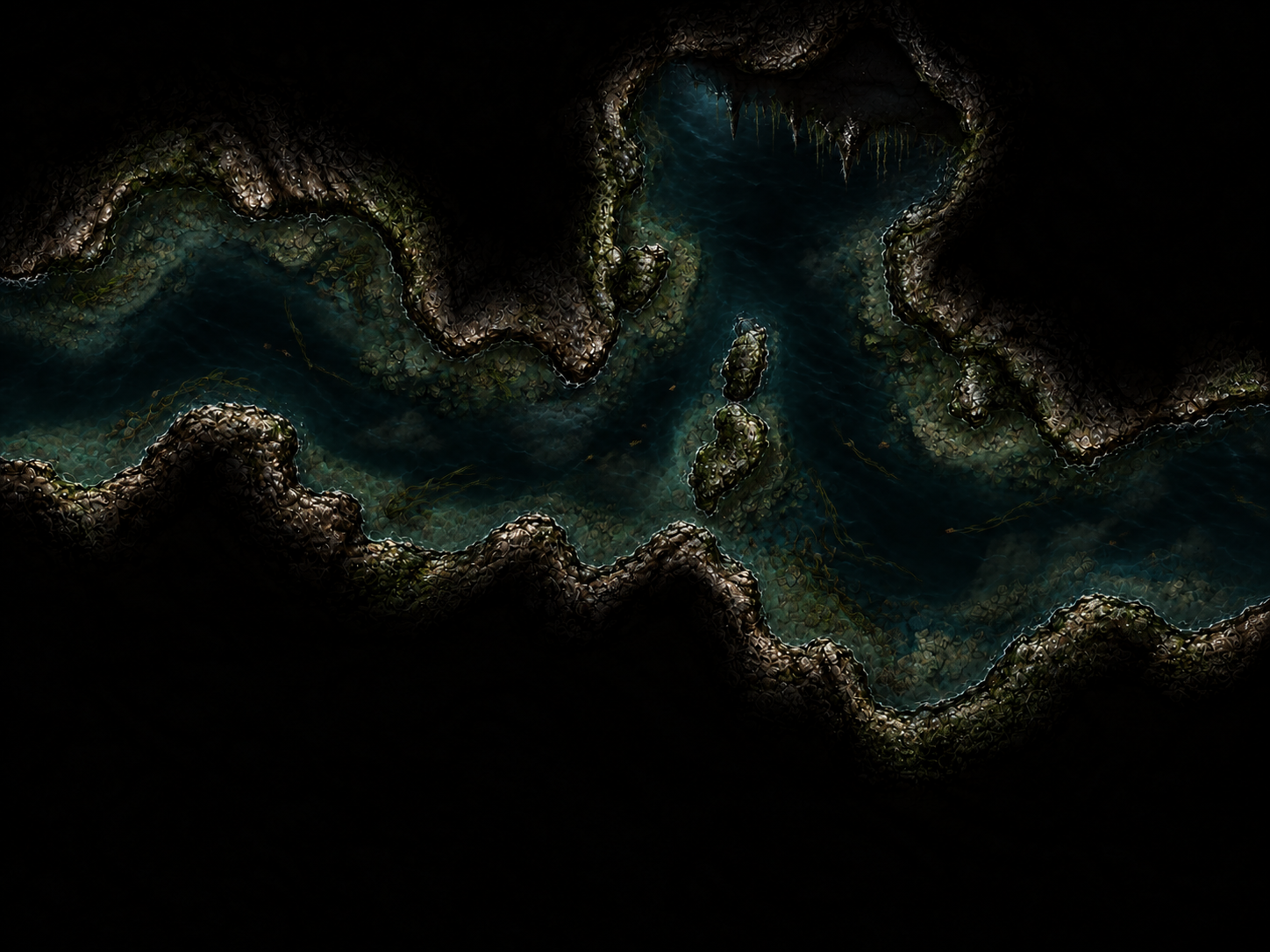
As Tlali drew closer, the water beside the apparent survivor exploded.
A huge reptilian head surged from beneath the surface, scattering freezing water across the riders and cave walls. Its jaws opened wide enough to seize a person or tear deeply into Tlali. Armoured plates emerged one after another across its skull, neck, shoulders, and back.
The force of the eruption drove a wall of deathly cold water across Tlali's back and knocked the apparent Inquisitor away from the shelf. Something resembling the remains of his missing boot hung among the predator's teeth, suggesting that it had already mauled him before the party arrived. Pulo vanished beneath the churned surface, apparently diving away from the sudden attack.
It was a young Ironhide Mauler, but its natural armour had been transformed. Crystalline Mutite formed along its osteoderms, creating an exceptionally hard shell across the top of its body. Gunfire or ordinary blows against the back would struggle to penetrate it. Only the underside, mouth, and eyes offered plausible weak points.
The mutite growth supplied a possible explanation for why several Merfolk lingered in the same cave as a predator that had little reason to eat drowned corpses. The creatures were known to be drawn towards mutite, while the mauler gained little nourishment from attacking them.
The creature's emergence threw the Inquisitor into the water. His apparent life had been an illusion created by the motions of a recent Merfolk. He had once been alive, and his equipment suggested he belonged to the five-person infiltration group, but he had already drowned and transformed before the party entered the cave.
Two more bodies moved in the disturbed water. One wore the rotted clothing of an old Freeport merchant or smuggler. The other was a little girl.
She was almost certainly Juliette.
All three Merfolk converged upon the living members of the party. The armoured mauler charged Tlali, while pale hands reached upwards around her riders.
The First Impact
The attack happened so quickly that for a moment the party could do little except react. The Ironhide Mauler erupted beside Tlali, while the three pale figures beneath the surface began moving towards the riders. In the poor torchlight it was difficult to distinguish bodies, limbs, ripples and shadows. The cave had changed in an instant from a narrow passage into a kill zone.
Barry shouted to rally the others out of their shock. His voice carried sharply through the confined space and helped Marco and Peg act before the creatures could completely overwhelm them. Marco concentrated on keeping Tlali under control as the larger predator struck against her and the smaller creatures reached up from below.
For a moment, retreat was considered. The entrance was still behind them and the group had not travelled especially far into the tunnel. Unfortunately, turning Tlali around in the cramped water would take time, she was burdened with several riders, and the mauler was far faster in the water. The Merfolk were already close enough to grab people from her back. Flight would merely turn the party away from their attackers while leaving the mauler free to pursue.
The party also considered the explosives they had brought. Barry Cuda still carried the severed leg he had lost during the previous session, including its boot. This inspired a gruesomely practical plan: place one of the bombs inside the boot, offer the leg to the mauler, and detonate the charge while it was in the animal's jaws or stomach.
Marco had anticipated needing the bombs quickly and had packed them close to the top of the baggage rather than burying them beneath everything else. Even so, accessible did not mean immediate. Somebody would still have to retrieve a bomb, fit it into the boot, arrange and light the fuse, and then deliver the leg to a creature already tearing at Tlali. Water splashing through the cave also made any exposed fuse unreliable. The idea remained potentially excellent if they could create a few seconds of breathing room, but they never received those seconds. Immediate survival forced them to abandon the preparation almost as soon as it began.
Peg drew her cutlass and began singing a sea shanty as the creatures closed. It was partly bravado and partly a way to keep herself steady in the darkness. Around her, the reflected torchlight flashed across wet stone, pale hands and the mauler's crystalline armour.
The Mauler Bites Tlali
The Ironhide Mauler attacked Tlali rather than one of the humans. Its jaws closed across her upper body, alarmingly close to the riders' hands and legs. The first bite tore deeply into her flesh. Tlali tried to wrench herself free, but the mauler maintained its hold and attacked again. Another crushing bite inflicted still more damage.
The individual wounds were enormous, on the order of fifteen or more points of injury apiece. Tlali's great size was the only reason she remained alive. Blood poured into the channel, spreading beneath the riders and further obscuring everything below the surface. Her movements became increasingly violent as she tried to escape the animal latched onto her.
The mauler's bulk, Tlali's attempts to twist free, and the uneven footing beneath the water made it impossible for all three riders to remain secure. Marco retained enough control to stay with Tlali. Barry Cuda and Peg were thrown from her back.
Peg fell close to a narrow shelf running beside the channel. She managed to keep her torch above the surface as she entered the water, then scrambled onto the stone with her cutlass ready. This left her in an awkward position: one hand held the only reliable light and the other held her weapon. She could illuminate the struggle or fight, but had no spare hand for climbing, grabbing a companion or securing herself.
Barry Cuda fell into deeper water. He could not swim, could not find the bottom, and immediately began sinking. The darkness beneath the surface swallowed almost all of the remaining light. Before he could orient himself, the pale shape of Juliette moved towards him.
Peg's torch was repeatedly struck by spray and partially submerged during the fighting. Protecting the flame limited which hand she could use, where she could move and how securely she could climb or fight. It did not go out altogether, but it dimmed until it cast little more light than a candle. From that point onward, even people above the water could see only fragments of the melee. Those beneath it were fighting in near-total darkness.
Marco Blinds the Mauler
Marco remained mounted while Tlali was being mauled. He immediately understood that attacking the creature's back was unlikely to accomplish anything. Its ordinary osteoderms were already formidable, and the growths of crystalline Mutite had turned the upper surface into something closer to plate armour. The eyes were among the only exposed targets available.
Marco committed fully to the first attack, sacrificing caution for the best possible chance of striking such a small target amid two thrashing animals. His cutlass drove through one eye and deep into the socket. The blow inflicted horrific damage, but the mauler did not release Tlali. It behaved like an ordinary crocodilian predator magnified into something much worse: pain and the loss of an eye did not interrupt the attack once its jaws had closed.
Marco attacked the second eye in the same fashion. The cutlass penetrated again, destroying the remaining eye and driving trauma into the skull. This finally pushed the creature beyond consciousness. Its jaws slackened, its body went limp, and it drifted away from Tlali.
The mauler was not dead. It had fallen unconscious after being reduced below its ability to keep fighting, and both eyes had been destroyed or damaged beyond any plausible short-term recovery. If it survived at all, recovery would take months and it would remain a blind ambush predator trapped in a cave where it could no longer hunt effectively. For the immediate fight, however, it was neutralised.
Marco had saved Tlali from the next bite, but the damage was already severe. She had been reduced to approximately -3 HP. She was bloodied, staggering and only narrowly still conscious. Marco could not stop to treat her while Barry Cuda and Peg were being pulled beneath the water.
Barry Is Dragged Under
Juliette reached Barry Cuda first and wrapped her arms around him. The body was that of a drowned child, but the creature did not move like a frightened or injured girl. It clung with the relentless strength of something that felt neither pain nor panic. Barry tried to wrench himself free and discovered that the water denied him leverage. He was stronger than the body grappling him, but he had no footing, could not see clearly, and was already sinking.
The other Merfolk moved towards the struggle. The recent Inquistador approached from behind while the older merchant circled between Barry and Peg. Their purpose became clear from the way they handled their victims. They were not trying to kill quickly with claws or teeth. They wanted to restrain a living person beneath the surface, compress the chest or force out the stored breath, and then press their mouths against the victim in the corrupted kiss of life that creates another Merfolk.
Barry had recently made a deliberate effort to learn wrestling, and that training was the only reason he could contest them at all. He repeatedly tried to strip Juliette's arms away or turn out of the hold. Several attempts failed. Underwater, even a simple struggle cost precious air, and every second spent fighting was another second in which he could not reach the surface.
Barry committed one of his limited bursts of swashbuckling fortune to escaping Juliette and still failed to improve the result. The dead child retained her hold despite an effort which would ordinarily have reversed a disastrous mistake.
Peg recognised the child's remains and called out Juliette's name. She hoped that the sound might provoke some memory or hesitation. Juliette gave no sign of comprehension. The Merfolk were not confused, traumatised people who could be reasoned back into themselves. Whatever animation remained in the body had no accessible human intelligence.
The Inquistador joined the attack whenever space opened behind Barry. Hands pressed against his torso and back, squeezing out air in bursts. At least one attempt to force the creature's mouth against his face failed, but the intention was unmistakable. Barry was not merely in danger of drowning. If the creatures succeeded, he might rise again as one of them.
His initial lungful of air gradually disappeared. The exertion of failed escapes consumed it faster than remaining still would have done, but remaining still meant submission. Once his breath was exhausted, each further interval underwater began draining his physical reserves. The likely sequence was now brutally clear: fatigue, loss of strength, unconsciousness, drowning and transformation.
Peg's Vine
From the shelf, Peg looked for anything that could reach Barry without forcing her to dive blindly after him. Thick jungle roots and vines had penetrated the cracks in the cave wall. She tore one free, tested as much of its length as she could in the moment, and cast it towards the place where Barry had vanished.
The first throw did not solve the problem. The vine landed near him, but near was not enough in dark, disturbed water. Barry could barely see its movement through the ripples and blood. Peg shouted that the line was there. Her voice became distorted by the water, yet Barry just managed to understand what she was telling him.
He then faced a miserable choice. Reaching blindly for the vine while Juliette held him would cost the same few seconds he needed to attempt another escape. If he missed, he would remain grappled and lose still more air. Barry chose to fight the hold first, hoping to create enough freedom to seize the line afterwards.
Peg was no longer safe on the shelf. The old merchant rose beneath her and seized her remaining living leg. Her wooden leg was on the other side; the creature had found the limb whose loss would leave her with no natural legs at all. Peg struck down with her cutlass and opened the arm holding her. The blow caused substantial damage, but Merfolk did not respond to injury like living opponents. The arm remained functional.
The merchant hauled her from the ledge. Peg went into the water still clutching the vine. For a time she managed to preserve both the line and her cutlass while trying to keep her head above the surface, but she now faced the same danger as Barry. Two separate rescue attempts had become two separate drownings.
Pulo Goes After Juliette
Marco sent Pulo after Juliette. Pulo plunged into the confused melee and snapped at the dead child. His first attack failed to secure her, but a later bite tore deeply into the body, ripping away sodden clothing and dead flesh. Juliette did not cry out, recoil or loosen her grip in pain. The attack damaged her, but ordinary injury did not interrupt her purpose.
More precisely, Juliette managed to evade Pulo's first snap in the dark water. The second connected and tore away packets of dead flesh rather than releasing a normal spray of living blood.
This clarified the tactical problem. The merfolk were already corpses. Hurting them in ways that would disable or frighten living people was unreliable. What mattered was function: if their arms were destroyed, they could no longer grapple; if they could no longer grapple, they could not hold somebody underwater long enough to transform them.
Barry finally broke Juliette's grip, but this did not bring him to safety. The recent Inquisitor immediately caught him from behind. The larger body locked around Barry's torso and compressed his chest, forcing out several more seconds' worth of precious air. Barry struggled free from that hold as well, but he remained submerged, disoriented and unable to swim upwards effectively.
Not every compression succeeded. During one attempt Barry resisted strongly enough to prevent the Inquistador from forcing additional air from his lungs. Juliette also tried to catch him again while Pulo was beginning the rescue and missed, buying them another critical second.
The exchange became a succession of brief freedoms and renewed captures. Barry would break one set of arms only for another body to drift within reach. Every success bought him a moment; none placed him on the surface. Eventually the breath he had taken before falling was gone. From that point forward the fight was being paid for with his remaining strength.
Marco Enters the Water
Once the mauler was unconscious, Marco manoeuvred the critically wounded Tlali towards a submerged shelf. He dismounted where the water was shallow enough to give him some footing. This made Marco another available target, which he deliberately accepted: drawing even one Merfolk away from Barry or Peg would improve their chances. He breathed and moved conspicuously while positioning himself to use the cutlass.
Marco ordered Pulo to dive after Barry. Pulo obeyed, descending through almost black water filled with blood, struggling bodies and the movement of the other merfolk. The task was not as simple as swimming to Barry. Pulo had to locate him, get close without becoming entangled, give Barry something to hold, and then swim upwards against whichever corpses were still pulling down.
Marco also had to make the purpose of the command clear. Pulo was a hungry carnivore entering water full of dead flesh and a helpless human. He had to recognise Barry as somebody to rescue rather than another edible object in the confusion.
Pulo reached him, but Barry's first attempt to secure a grip failed. Pulo's size, darkness and constant movement made it difficult to grasp the right part of his body securely. Barry's hands met scales and moving water without finding a reliable hold. Pulo had to remain close and try again while the merfolk continued their attack. At points the struggle carried Barry closer to the bottom rather than the surface.
When Barry finally caught Pulo, the dinosaur began swimming upwards. The Merfolk pulled in the opposite direction, turning Pulo into one side of a submerged tug-of-war. Barry could contribute little beyond holding on. He was exhausted, unable to swim, and still being seized whenever one of the creatures found an opening.
Saving Peg
Peg was still being held by the old merchant. She slashed at the grasping arm again, but a cutlass was difficult to swing effectively underwater and the previous wound had not disabled it. Keeping her weapon also denied her the second hand she needed to pry the creature loose.
Before being pulled in, Peg had considered snagging her first vine around a projecting rock so that it would become an anchored rescue line without occupying her hand. There was no conveniently placed anchor, and arranging one deliberately would have taken more time than the attack allowed.
Marco found and cut another length of vine, then threw it towards her. Peg managed to catch or gather the line while the merchant continued pulling at her leg. She was now connected to Marco, but the Merfolk remained connected to her. Pulling harder would not automatically free her; it might simply stretch her between them.
Peg eventually released her cutlass and the unsecured vine she had been managing so she could oppose the merchant's two-handed hold with both hands. She spent the last of her immediate good fortune and effort wrenching against its grip while Marco braced on the shelf and hauled the second vine. The contest lasted through several attempts rather than resolving with a single pull.
At last the merchant's damaged arm lost its purchase. Marco dragged Peg onto the stone ledge. The Merfolk immediately reached after her again, forcing Peg to scramble farther back rather than collapsing at the water's edge. She escaped the renewed grasp and remained above the surface.
Her Cutlass had been lost into the water during the rescue. After the fight, the party guided a vine towards the place where it had drifted and recovered it. Peg was soaked, exhausted and temporarily disarmed, but she was now in a position to help [[Barry Cuda (Sam Bebbington)|Barry].
Barry Reaches the Surface
Underwater, the rescue advanced and reversed in increments. Pulo gained a yard, one of the Merfolk found Barry again, and the combined weight pulled him back. Barry broke a hold, failed to improve his grip, and lost another second. From his perspective there was no clear direction, only darkness, pressure and the occasional dim suggestion of the torch above.
Pulo's first successful efforts brought Barry yard by yard from near the bottom until he was only one yard beneath fresh air. Pulo eventually hauled him high enough for his face to break the surface. Barry managed to take a breath before the creatures dragged him down again. That breath was decisive even though it did not end the danger. It interrupted the progression towards unconsciousness and gave him another reserve with which to keep fighting.
The pattern repeated. Barry surfaced, inhaled, and vanished again. Pulo pulled upwards; pale arms pulled down. The movement resembled a random walk through the water, with neither side maintaining control for long. Each appearance above the surface reassured the others that Barry was still conscious, but none lasted long enough for him to climb free.
Now safely on the shelf, Peg cast the vine towards him again while Marco helped control its length. Pulo did not only raise Barry vertically; he also pushed him laterally towards the shelf and the drifting rescue line. Barry heard Peg's warning and reached for it. This time he caught it with an exceptionally secure grip. The rescue line joined all of their efforts together: Marco and Peg braced above the water, Pulo pushed and pulled from below, and Barry held on while resisting the Merfolk.
This changed the balance. The creatures were no longer dragging a single unsupported non-swimmer through open water. Every attempt to pull Barry down now had to overcome several members of the party and a line anchored against the stone.
Dismembering the Merfolk
With a line on Barry and firmer footing beneath himself, Marco could finally attack the Merfolk systematically. He did not waste effort hacking at torsos which might continue moving after mortal wounds. He targeted the arms actively holding Barry.
The Inquistador's armour protected much of its body, but the exposed limbs were vulnerable. Marco used rapid, fully committed cutlass strikes against one arm and then the other. One was severed or rendered completely useless; the second followed. The corpse continued to kick and writhe, but without functioning arms it could no longer close a grapple or press Barry beneath the surface.
Marco then turned his attention to Juliette. The sight was grim: rescuing Barry required deliberately hacking the arms from the body of the child they had promised to find. Both limbs were crippled in quick succession. Juliette remained animate and continued trying to move towards the living, but she no longer had the physical means to hold anybody.
The old merchant still possessed enough function to interfere from the edge of the struggle. Peg and Marco kept the vine taut while Pulo brought Barry closer to the ledge. The rescue remained contested until Barry was near enough to contribute more than simply holding on.
One of the merfolk caught him a final time with its last useful arm. Barry struck it with his bare hand, spending the last of his strength to make the blow count. The impact dislocated, tore or otherwise destroyed the shoulder so thoroughly that the arm ceased to function. The final effective grapple ended.
The three Merfolk had not been killed in any conventional sense. They remained animate, drifting, kicking or writhing in the water with ruined limbs. They could still move and might remain dangerous to somebody careless enough to put a hand near their mouths, but they could no longer seize, drown or transform anyone.
They were not destroyed, but deprived of the anatomy required to continue the fight. Juliette, the merchant and the Inquistador were all left in some version of this state. Only once all three had been functionally disarmed could Barry finally be hauled onto the shelf and allowed to breathe without immediately being dragged back into the black water.
Treating Tlali
Only after Barry and Peg were secure could the party turn back to Tlali. The mauler's repeated bites had left enormous punctures and crushing injuries across her upper body. She had somehow remained conscious despite being reduced to approximately -3 HP, but without treatment she could easily have collapsed and died inside the cave.
Marco began first aid immediately. The treatment went extraordinarily well. He cleaned and packed the wounds, stopped the worst bleeding and stabilised injuries which had looked catastrophic moments earlier. Because Tlali was so much larger than a human, the successful treatment restored an equally outsized amount of health: approximately 16 HP, bringing her from -3 HP to 13 HP.
Tlali was therefore no longer on the edge of death. She remained one point short of the threshold at which she could move and defend herself normally, meaning the group would have to travel at roughly half speed unless she recovered further. The remaining journey of around twelve miles, perhaps three hours under good conditions, could therefore take closer to six. Even so, this was an astonishing improvement over the likelihood of having to abandon or euthanise her in the cave.
Pulo remained functional after the fight. He had not been the mauler's wounded target, and his repeated dives had been crucial to Barry's survival. Without him, Barry would almost certainly have exhausted himself before the vine could be secured.
What Remained in the Cave
The unconscious Ironhide Mauler floated nearby. Its Mutite-reinforced armour could be valuable to the right buyer, and its body might provide meat or other useful materials. It was still alive at the end of the session, although its destroyed eyes made its long-term survival doubtful.
The party discussed harvesting the animal for meat, mutite and hide or selling its remains to an appropriate buyer. This had not yet been done: it remained unconscious rather than dead, and dealing with it would require a deliberate decision next session.
The crystalline armour also prompted Peg to remember a Samaran belief that mutite crystals can carry or ferry souls between worlds. Nobody knew whether that belief had any bearing upon this particular mauler, but its body now combined living flesh, mutite growth and the site of several recent deaths.
The recent Inquistador corpse still carried infiltration equipment, sealed pouches, weapons, and other possessions that had not yet been fully searched or inventoried.
The identities of the other two Merfolk were now reasonably clear:
- The child was almost certainly Juliette, the missing sister of the boy outside.
- The adult in old merchant's clothing was probably a smuggler who had discovered or used Fortune's Grave years earlier.
- The newly transformed Inquistador had probably been one of the five men seen emerging from the tunnel at approximately 10:00 p.m. before Redd James' departure.
The remaining four members of that group had already entered Freeport. The party did not yet know their mission, identities, or current location.
The party considered taking some recognisable part of Juliette back to her brother so that he and his father would finally know what had happened. Because the body remained animate and dangerous, even this would require care. No remains had yet been removed from the cave.
They also returned to the warning attached to Fortune's Grave: one might escape the cave while leaving their luck behind because the cave fed upon it. After the ambush, the legend no longer sounded entirely metaphorical. Someone even raised the possibility that this might not be the intended passage at all. Hunchback Jim's supporters always maintained that apparent errors meant his listeners had misunderstood him, and the party could not yet prove that every part of the poem had been interpreted correctly.
End Position
At the end of the session:
- Marco, Peg, and Barry had found the entrance to Fortune's Grave.
- The route had been revealed by a poem in one of Bennett's stolen books, interpreted through Hunchback Jim and the statue of Edward Stormbreaker.
- Five suspicious men had emerged from the passage at approximately 10:00 p.m. on the night before Redd James used it.
- At least one of those men was an Inquisitor who had died and transformed into a Merfolk within the cave.
- Redd James and his companions had entered the tunnel from the Freeport side at approximately 8:00 a.m. the following morning.
- The party had defeated three Merfolk by disabling their arms rather than permanently destroying them.
- Marco had blinded and incapacitated a young, Mutite-armoured Ironhide Mauler.
- Barry had nearly drowned but was conscious and breathing.
- Peg had also been dragged into the water but escaped with Marco's help.
- Pulo remained capable of travelling and had helped haul Barry back to the surface.
- Tlali had been brought back from the brink of death and now had approximately 13 HP, still just below normal movement and defensive capacity.
- The Inquistador's equipment and the mauler's body remained available for examination or recovery.
- The party chose not to return to Freeport. Their intention was to continue through Fortune's Grave, emerge beyond Gustavo's blockade, and travel the remaining distance towards Atzalco.
The route ahead was expected to require approximately another three to six hours depending upon Tlali's reduced speed, the remaining length of the tunnel, the coastal conditions, and whether Fortune's Grave contained anything else.
The party expected the overland portion alone to take closer to six hours at Tlali's present half speed, rather than the roughly three hours it might ordinarily require. They intended to give her an opportunity to rest once she recovered at least one additional point of health and regained normal movement and defensive ability.